\(\sqrt{a^{2}-x^{2}}\)
\(x = a\sin\theta\)
\(dx = a\cos\theta\,d\theta\)
\(\sqrt{a^{2}+x^{2}}\)
\(x = a\tan\theta\)
\(dx = a\sec^{2}\theta\,d\theta\)
\(\sqrt{x^{2}-a^{2}}\)
\(x = a\sec\theta\)
\(dx = a\sec\theta\tan\theta\,d\theta\)
Evaluate \(\displaystyle\int\dfrac{1}{\sqrt{x^{2}+9}}\,dx\)
1st: Identify the form & choose substitution
\(\sqrt{x^{2}+a^{2}}\) with \(a=3\) → \(x = 3\tan\theta\), \(dx = 3\sec^{2}\theta\,d\theta\)
Reference Triangle
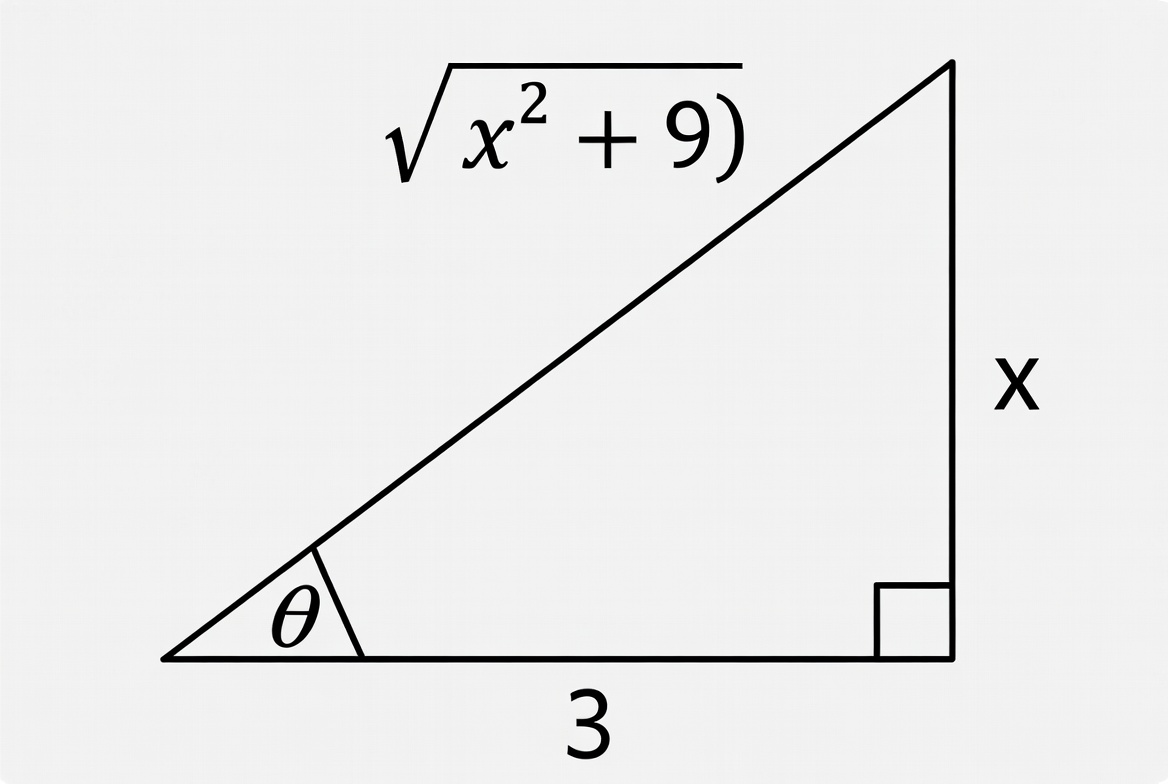
2nd: Simplify the square root
\(\sqrt{x^{2}+9} = \sqrt{9\tan^{2}\theta + 9} = \sqrt{9(\tan^{2}\theta + 1)} = \sqrt{9\sec^{2}\theta} = 3\sec\theta\)
(using \(1 + \tan^{2}\theta = \sec^{2}\theta\))
3. Substitute
\(\displaystyle\int\dfrac{3\sec^{2}\theta}{3\sec\theta}\,d\theta = \int\sec\theta\,d\theta\)
4. Integrate & back-substitute
\(\ln|\sec\theta + \tan\theta| + C\)
\(\ln\left|\sqrt{x^{2}+9} + x\right| + C\)
Easy
Direct application of one of the three forms
\(\displaystyle\int\sqrt{9-x^{2}}\,dx\)
Show Answer
1st: Choose substitution
\(x = 3\sin\theta\), \(dx = 3\cos\theta\,d\theta\)
Reference Triangle

hypotenuse = 3, opposite = \(x\), adjacent = \(\sqrt{9-x^{2}}\)
2nd: Simplify the square root
\(\sqrt{9-x^{2}} = \sqrt{9-9\sin^{2}\theta} = \sqrt{9(1-\sin^{2}\theta)} = \sqrt{9\cos^{2}\theta} = 3\cos\theta\)
(using \(\sin^{2}\theta + \cos^{2}\theta = 1\))
3. Substitute
\(\displaystyle\int\sqrt{9-x^{2}}\,dx = \int(3\cos\theta)(3\cos\theta)\,d\theta = 9\int\cos^{2}\theta\,d\theta\)
4. Integrate (power-reduction formula)
Use \(\cos^{2}\theta = \dfrac{1+\cos 2\theta}{2}\):
\(9\int\dfrac{1+\cos 2\theta}{2}\,d\theta = \dfrac{9}{2}\theta + \dfrac{9}{4}\sin 2\theta + C\)
Since \(\sin 2\theta = 2\sin\theta\cos\theta\):
\(\dfrac{9}{2}\theta + \dfrac{9}{2}\sin\theta\cos\theta + C\)
5. Back-substitute
\(\sin\theta = \dfrac{x}{3}\), \(\cos\theta = \dfrac{\sqrt{9-x^{2}}}{3}\), \(\theta = \arcsin\dfrac{x}{3}\)
\(\dfrac{9}{2}\arcsin\dfrac{x}{3} + \dfrac{x\sqrt{9-x^{2}}}{2} + C\)
\(\displaystyle\int\dfrac{1}{\sqrt{x^{2}+4}}\,dx\)
Show Answer
1st: Choose substitution
\(x = 2\tan\theta\), \(dx = 2\sec^{2}\theta\,d\theta\)
Reference Triangle

adjacent = 2, opposite = \(x\), hypotenuse = \(\sqrt{x^{2}+4}\)
2nd: Simplify the square root
\(\sqrt{x^{2}+4} = \sqrt{4\tan^{2}\theta + 4} = \sqrt{4(\tan^{2}\theta + 1)}\)
Use \(1 + \tan^{2}\theta = \sec^{2}\theta\):
\(= \sqrt{4\sec^{2}\theta} = 2\sec\theta\)
3. Substitute
\(\displaystyle\int\dfrac{1}{\sqrt{x^{2}+4}}\,dx = \int\dfrac{2\sec^{2}\theta}{2\sec\theta}\,d\theta = \int\sec\theta\,d\theta\)
4. Integrate
\(\int\sec\theta\,d\theta = \ln|\sec\theta + \tan\theta| + C\)
5. Back-substitute
\(\tan\theta = \dfrac{x}{2}\), \(\sec\theta = \dfrac{\sqrt{x^{2}+4}}{2}\)
\(\ln\left|\dfrac{\sqrt{x^{2}+4}}{2} + \dfrac{x}{2}\right| + C = \ln\left|\dfrac{\sqrt{x^{2}+4} + x}{2}\right| + C\)
Using log properties:
\(\ln\left|\sqrt{x^{2}+4} + x\right| – \ln 2 + C\)
\(\ln 2\) is a constant, so it can be absorbed into the arbitrary constant \(C\):
\(\ln\left|\sqrt{x^{2}+4} + x\right| + C\)
\(\displaystyle\int\dfrac{1}{x^{2}\sqrt{x^{2}-1}}\,dx\)
Show Answer
1st: Choose substitution
\(x = \sec\theta\), \(dx = \sec\theta\tan\theta\,d\theta\)
Reference Triangle

adjacent = 1, opposite = \(\sqrt{x^{2}-1}\), hypotenuse = \(x\)
2nd: Simplify the square root
\(\sqrt{x^{2}-1} = \sqrt{\sec^{2}\theta – 1}\)
Use \(1 + \tan^{2}\theta = \sec^{2}\theta\) → \(\sec^{2}\theta – 1 = \tan^{2}\theta\):
\(= \tan\theta\)
3. Substitute
\(\displaystyle\int\dfrac{1}{x^{2}\sqrt{x^{2}-1}}\,dx = \int\dfrac{\sec\theta\tan\theta}{\sec^{2}\theta\cdot\tan\theta}\,d\theta\)
Cancel \(\tan\theta\) (assuming \(\tan\theta\neq 0\)):
\(= \int\dfrac{1}{\sec\theta}\,d\theta = \int\cos\theta\,d\theta\)
4. Integrate
\(\int\cos\theta\,d\theta = \sin\theta + C\)
5. Back-substitute
From the triangle: \(\sin\theta = \dfrac{\text{opposite}}{\text{hypotenuse}} = \dfrac{\sqrt{x^{2}-1}}{x}\)
\(\dfrac{\sqrt{x^{2}-1}}{x} + C\)
Medium
Requires careful simplification after substitution
\(\displaystyle\int\dfrac{\sqrt{x^{2}-36}}{x}\,dx\)
Show Answer
1st: Choose substitution
\(x = 6\sec\theta\), \(dx = 6\sec\theta\tan\theta\,d\theta\)
Reference Triangle

adjacent = 6, opposite = \(\sqrt{x^{2}-36}\), hypotenuse = \(x\)
2nd: Simplify the square root
\(\sqrt{x^{2}-36} = \sqrt{36\sec^{2}\theta – 36} = \sqrt{36(\sec^{2}\theta – 1)}\)
Use \(1 + \tan^{2}\theta = \sec^{2}\theta\) → \(\sec^{2}\theta – 1 = \tan^{2}\theta\):
\(= \sqrt{36\tan^{2}\theta} = 6\tan\theta\)
3. Substitute
\(\displaystyle\int\dfrac{\sqrt{x^{2}-36}}{x}\,dx = \int\dfrac{6\tan\theta}{6\sec\theta}\cdot 6\sec\theta\tan\theta\,d\theta\)
Simplify:
\(= \int 6\tan^{2}\theta\,d\theta\)
4. Integrate
Use the identity \(\tan^{2}\theta = \sec^{2}\theta – 1\):
\(6\int(\sec^{2}\theta – 1)\,d\theta = 6(\tan\theta – \theta) + C\)
5. Back-substitute
\(\tan\theta = \dfrac{\sqrt{x^{2}-36}}{6}\), \(\theta = \sec^{-1}\dfrac{x}{6}\)
\(6\left(\dfrac{\sqrt{x^{2}-36}}{6} – \sec^{-1}\dfrac{x}{6}\right) + C\)
\(\sqrt{x^{2}-36} – 6\sec^{-1}\dfrac{x}{6} + C\)
\(\displaystyle\int\dfrac{x^{2}}{\sqrt{x^{2}+4}}\,dx\)
Show Answer
1st: Choose substitution
\(x = 2\tan\theta\)
Reference Triangle
Final answer
\(\dfrac{x}{2}\sqrt{x^{2}+4} – 2\ln|x + \sqrt{x^{2}+4}| + C\)
\(\displaystyle\int\dfrac{\sqrt{25-x^{2}}}{x^{2}}\,dx\)
Show Answer
1st: Choose substitution
\(x = 5\sin\theta\)
Reference Triangle

Final answer
\(-\dfrac{\sqrt{25-x^{2}}}{x} – \arcsin\dfrac{x}{5} + C\)