Jump to section:
Tip: Search these exact Question IDs in the College Board SAT Suite Question Bank, Advanced Math, skill Nonlinear functions for full questions and rationales.
Maximum on a Graph
Read the highest point on the graph.
Show Answer
The parabola opens down, so the highest point is a maximum.
The highest point is (−3, 5).
The x-value of that point is −3.
Answer: −3
Show Answer
The graph opens down, so the highest point is the maximum height.
The highest point is at 2 seconds and 32 feet.
The maximum height is 32 feet.
Answer: 32 feet
Vertex, Axis, and Minimum
Graph in Desmos. You can also use vertex form, symmetry, or the vertex formula.
Show Answer
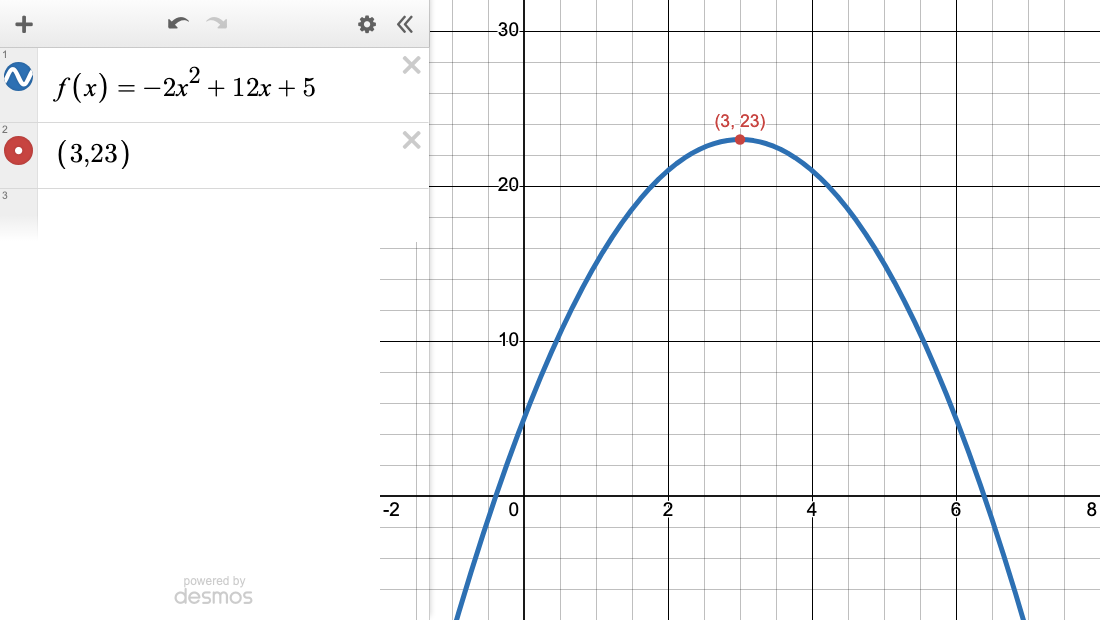
In Desmos, graph f(x) = −2x² + 12x + 5.
The parabola opens down because a = −2, so the vertex is a maximum.
The x-value of the vertex is
x = −b2a.
a = −2 and b = 12.
x = −122(−2).
x = −12−4.
x = 3.
f(3) = −2(3²) + 12(3) + 5.
f(3) = −18 + 36 + 5.
f(3) = 23.
Answer: 23
Show Answer
f(x) − 6 = x² + 5x.
Add 6 to both sides.
f(x) = x² + 5x + 6.
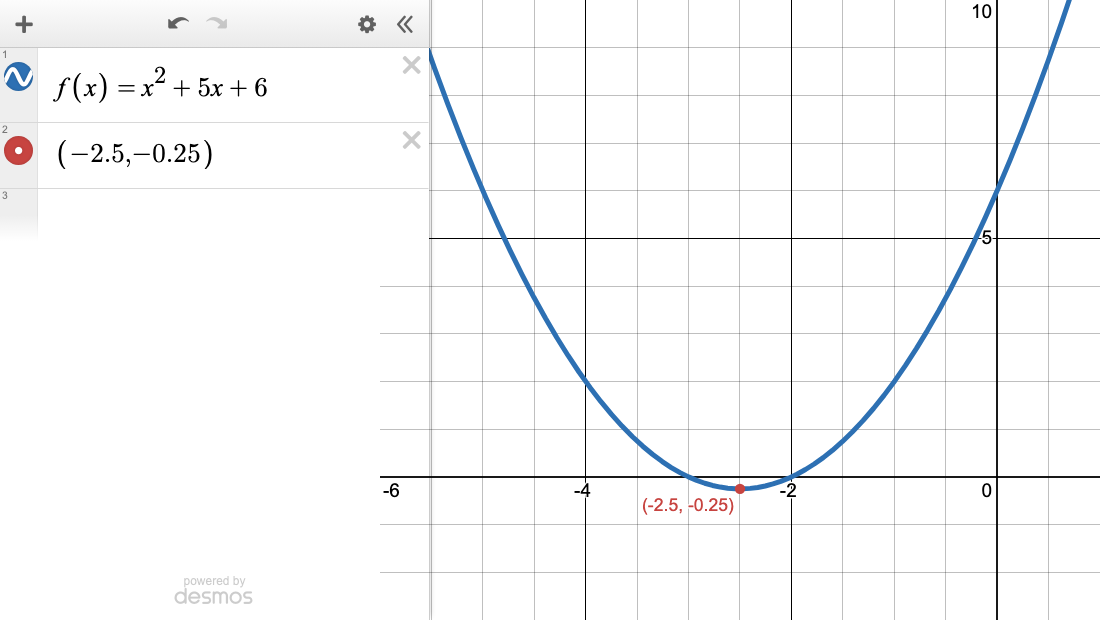
In Desmos, graph f(x). The parabola opens up, so the lowest point is a minimum.
The x-value of the vertex is
x = −b2a.
a = 1 and b = 5.
x = −52 · 1.
x = −52.
Desmos shows that same x-value as −2.5.
Answer: −52
Show Answer
Vertex form is g(x) = a(x − h)² + k.
The vertex is (h, k).
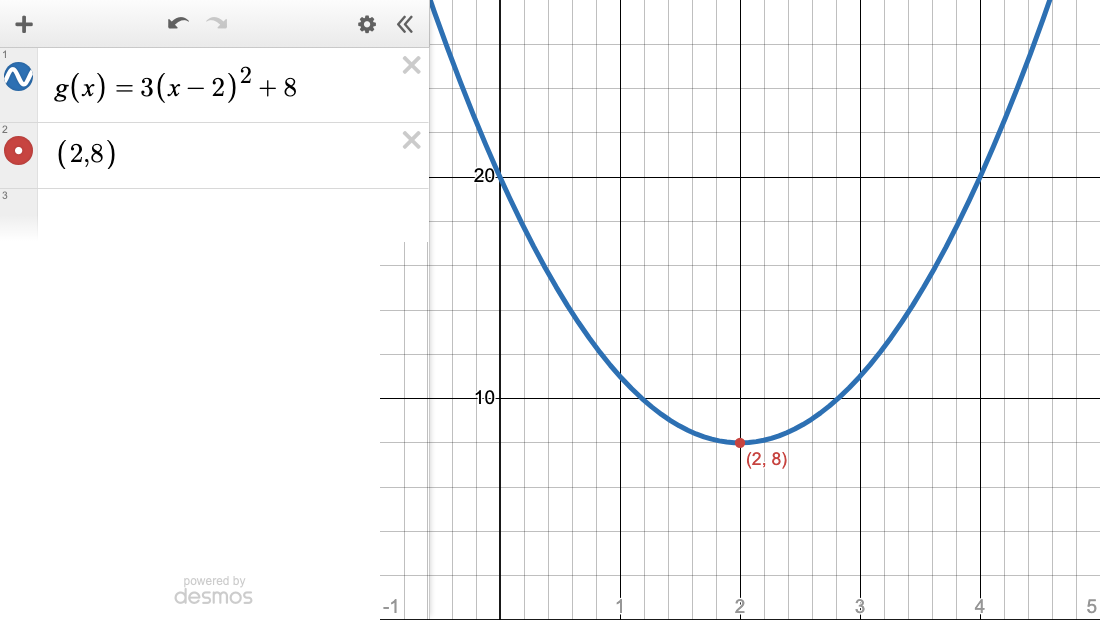
g(x) = 3(x − 2)² + 8.
h = 2 and k = 8.
In Desmos, the turning point of the graph is (2, 8).
Answer: (2, 8)
Show Answer
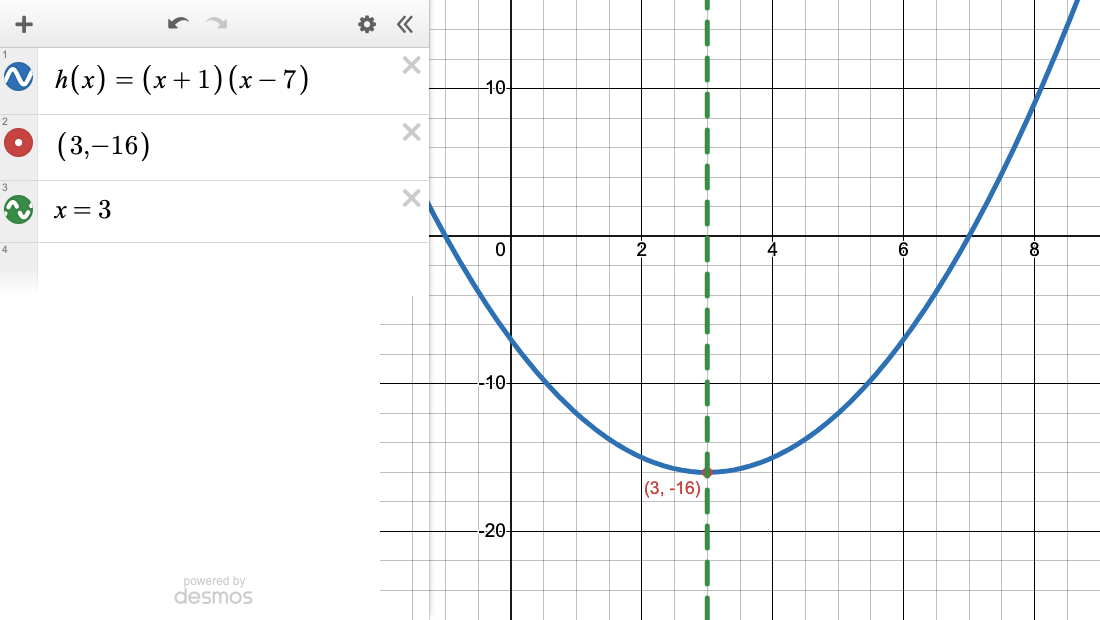
h(x) = (x + 1)(x − 7).
The x-intercepts are x = −1 and x = 7.
The axis of symmetry is halfway between the intercepts.
x = −1 + 72.
x = 62.
x = 3.
In Desmos, that is the vertical line through the vertex.
Answer: x = 3
Show Answer
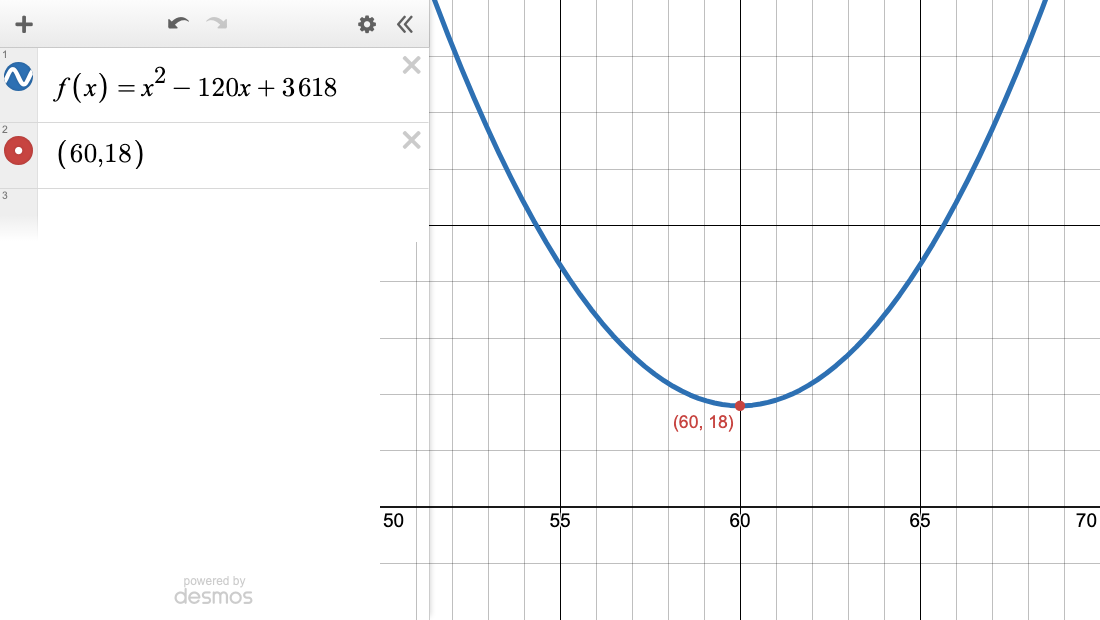
f(x) = x² − 120x + 3618.
The y-intercept is 3618. The minimum is the y-value of the vertex.
In Desmos, graph f(x) and zoom until the lowest point is on the screen.
The x-value of the vertex is
x = −b2a.
a = 1 and b = −120.
x = −(−120)2 · 1.
x = 1202.
x = 60.
f(60) = 60² − 120(60) + 3618.
f(60) = 3600 − 7200 + 3618.
f(60) = 18.
Answer: 18
Show Answer
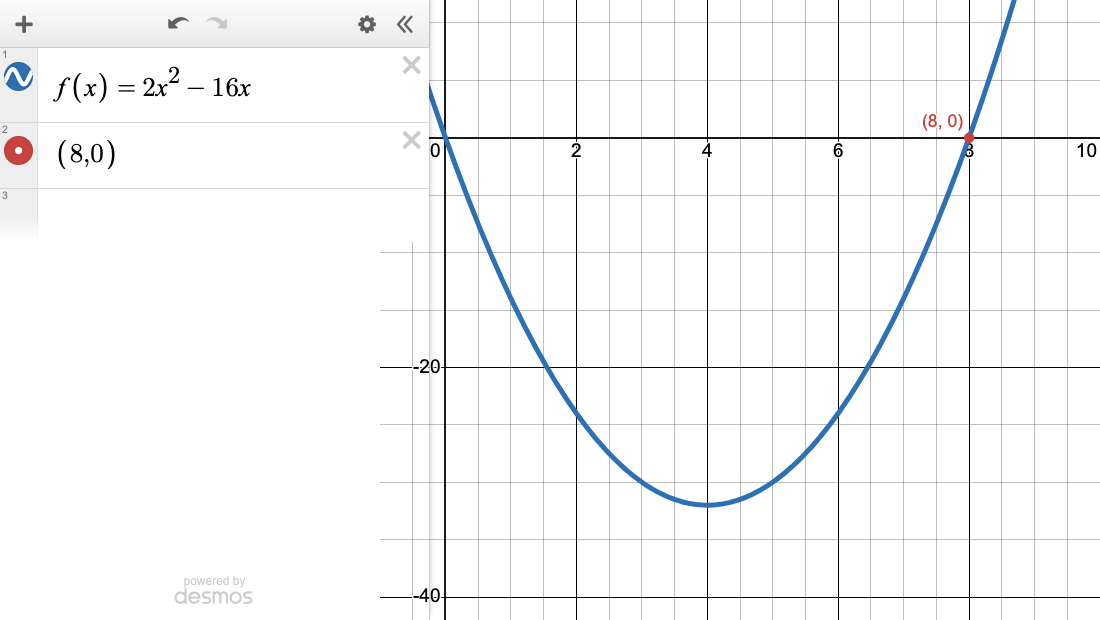
f(x) = 2x² − 16x.
Factor.
f(x) = 2x(x − 8).
The x-intercepts are the solutions of f(x) = 0.
2x = 0 or x − 8 = 0.
x = 0 or x = 8.
The intercepts are (0, 0) and (8, 0).
In Desmos, the graph crosses the x-axis at 0 and at 8.
Answer: 8
Quadratic Number Theory
Let n be the smaller positive integer. Write an equation, then solve by factoring.
Show Answer
Let n be the smaller positive odd integer.
The next consecutive odd integer is n + 2.
n² + (n + 2)² = 394
(n + 2)² = n² + 4n + 4
Substitute.
n² + (n² + 4n + 4) = 394
2n² + 4n + 4 = 394
Subtract 394 from both sides.
2n² + 4n + 4 − 394 = 0
2n² + 4n − 390 = 0
Divide both sides by 2.
n² + 2n − 195 = 0
Find two numbers that multiply to −195 and add to 2.
15 and −13.
15 · (−13) = −195
15 + (−13) = 2
(n + 15)(n − 13) = 0
Set each factor equal to zero.
n = −15 is not positive.
The next consecutive odd integer is n + 2.
n + 2 = 13 + 2
n + 2 = 15
Check.
13² = 169
15² = 225
169 + 225 = 394
Answer: the two integers are 13 and 15
Show Answer
Let n be the smaller positive odd integer.
The next consecutive odd integer is n + 2.
n² + (n + 2)² = 802
(n + 2)² = n² + 4n + 4
Substitute.
n² + (n² + 4n + 4) = 802
2n² + 4n + 4 = 802
Subtract 802 from both sides.
2n² + 4n + 4 − 802 = 0
2n² + 4n − 798 = 0
Divide both sides by 2.
n² + 2n − 399 = 0
Find two numbers that multiply to −399 and add to 2.
21 and −19.
21 · (−19) = −399
21 + (−19) = 2
(n + 21)(n − 19) = 0
Set each factor equal to zero.
n = −21 is not positive.
The next consecutive odd integer is n + 2.
n + 2 = 19 + 2
n + 2 = 21
Check.
19² = 361
21² = 441
361 + 441 = 802
Answer: the two integers are 19 and 21
Show Answer
Let n be the smaller positive integer.
The other integer is n + 6.
n(n + 6) + n + (n + 6) = 111
n(n + 6) = n² + 6n
n + (n + 6) = 2n + 6
Substitute.
n² + 6n + 2n + 6 = 111
n² + 8n + 6 = 111
Subtract 111 from both sides.
n² + 8n + 6 − 111 = 0
n² + 8n − 105 = 0
Find two numbers that multiply to −105 and add to 8.
15 and −7.
15 · (−7) = −105
15 + (−7) = 8
(n + 15)(n − 7) = 0
Set each factor equal to zero.
n = −15 is not positive.
The other integer is n + 6.
n + 6 = 7 + 6
n + 6 = 13
Check.
7 · 13 = 91
7 + 13 = 20
91 + 20 = 111
Answer: the two integers are 7 and 13
Show Answer
Let n be the smaller positive integer.
The other integer is n + 4.
n(n + 4) + n + (n + 4) = 116
n(n + 4) = n² + 4n
n + (n + 4) = 2n + 4
Substitute.
n² + 4n + 2n + 4 = 116
n² + 6n + 4 = 116
Subtract 116 from both sides.
n² + 6n + 4 − 116 = 0
n² + 6n − 112 = 0
Find two numbers that multiply to −112 and add to 6.
14 and −8.
14 · (−8) = −112
14 + (−8) = 6
(n + 14)(n − 8) = 0
Set each factor equal to zero.
n = −14 is not positive.
The other integer is n + 4.
n + 4 = 8 + 4
n + 4 = 12
Check.
8 · 12 = 96
8 + 12 = 20
96 + 20 = 116
Answer: the two integers are 8 and 12
Show Answer
Let n be the smaller positive integer.
The other integer is n + 9.
n(n + 9) + n + (n + 9) = 219
n(n + 9) = n² + 9n
n + (n + 9) = 2n + 9
Substitute.
n² + 9n + 2n + 9 = 219
n² + 11n + 9 = 219
Subtract 219 from both sides.
n² + 11n + 9 − 219 = 0
n² + 11n − 210 = 0
Find two numbers that multiply to −210 and add to 11.
21 and −10.
21 · (−10) = −210
21 + (−10) = 11
(n + 21)(n − 10) = 0
Set each factor equal to zero.
n = −21 is not positive.
The other integer is n + 9.
n + 9 = 10 + 9
n + 9 = 19
Check.
10 · 19 = 190
10 + 19 = 29
190 + 29 = 219
Answer: the two integers are 10 and 19
Ready to master quadratic functions?